

TL;DR:
- Marketing automation uses software to manage and measure marketing tasks across channels without manual effort. It relies on unified customer data, behavioral triggers, and AI-driven tools to create personalized, scalable customer experiences. Success depends on starting small, continuously monitoring workflows, and ensuring organizational alignment to scale effectively.
Marketing automation is defined as the use of software to automatically execute, manage, and measure marketing tasks and campaigns across multiple channels without manual intervention. Business leaders who deploy it correctly replace repetitive, error-prone manual work with data-driven workflows that run 24 hours a day. The results compound fast. SMS reaches up to 98% of recipients, compared to email open rates that average 20–30%. That gap alone explains why omnichannel automation outperforms any single-channel approach. 84% of sales and marketing professionals report that AI saves time and reduces manual workload. The real goal is not just saving hours. It is building a system that creates adaptive customer experiences at any scale.
What are the key components of marketing automation?
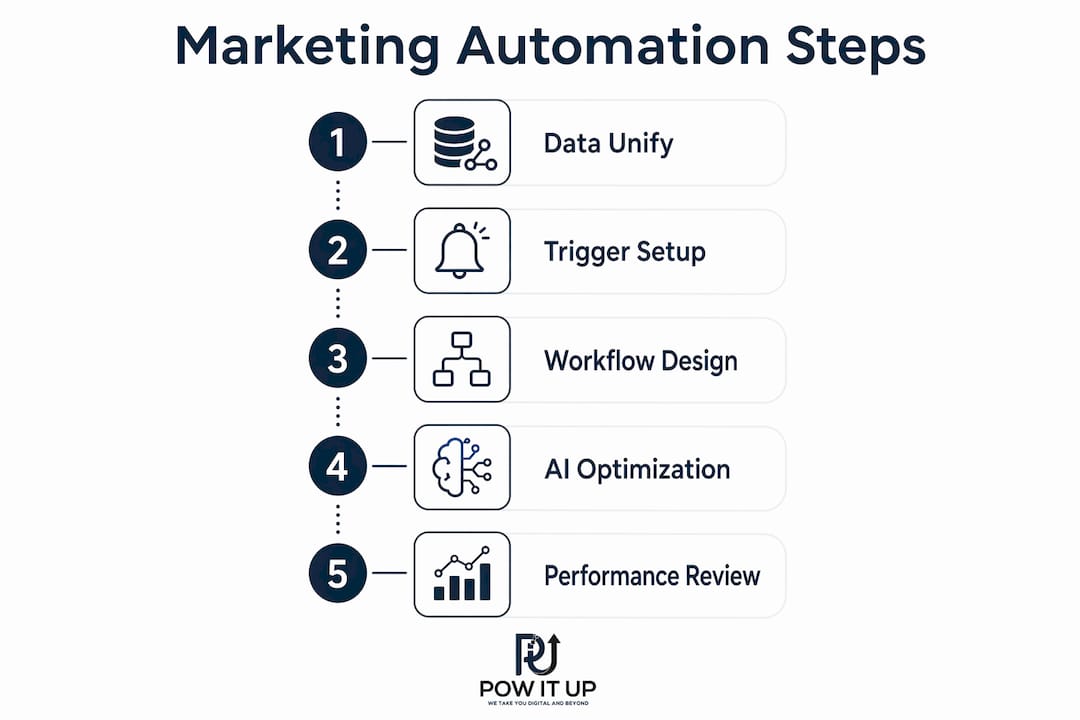
Effective marketing automation starts with a single, unified view of your customer. Fragmented data leads to irrelevant messages that damage brand trust. When your CRM, website behavior data, and transaction history live in separate systems, your campaigns send the wrong message to the wrong person at the wrong time. Unifying those data sources into one real-time foundation is the prerequisite for everything else.
Once your data is unified, you need the following core capabilities in place:
- Multi-channel orchestration. Your platform must coordinate email, SMS, push notifications, and social media from a single workflow engine. Siloed channel tools create inconsistent customer experiences.
- Behavioral triggers. The system must respond to real customer actions, such as a page visit, a purchase, or a form submission, not just scheduled send times.
- AI-driven analytics and scoring. Machine learning models rank leads by purchase intent and predict which contacts are most likely to convert. This replaces manual list segmentation.
- Dynamic content personalization. Messages must adapt to individual contact attributes and behaviors automatically, not through manual template swaps.
- Integration with your existing tech stack. Your automation platform must connect cleanly to your CRM, e-commerce system, and analytics tools without creating new data silos.
Stitching together multiple point solutions creates technical debt and data fragmentation. Integrated Customer Engagement Platforms that unify data and AI in one system consistently outperform collections of disconnected tools.
Pro Tip: Start with one or two channels before adding more. A well-executed email and SMS workflow beats a poorly configured five-channel setup every time.

How do you design workflows that drive real results?
A marketing automation workflow is a sequence of actions triggered by a specific customer behavior or lifecycle event. The design process starts with defining your triggers precisely. Vague triggers produce vague results. A trigger like “user visited pricing page twice in 7 days” is far more useful than “user showed interest.”
The highest-impact workflows follow a predictable pattern:
- Welcome series. Triggered when a new contact subscribes or registers. Send three to five messages over the first two weeks that introduce your brand, set expectations, and deliver immediate value.
- Abandoned cart recovery. Triggered when a shopper adds items but does not complete purchase. A sequence of two to three messages sent within 24 hours recovers a significant share of lost revenue.
- Lead nurture sequences. Triggered by content downloads or demo requests. These multi-step workflows move prospects through the funnel with progressively more specific content.
- Re-engagement campaigns. Triggered when a contact goes inactive for 60 or 90 days. A short sequence with a clear offer tests whether the contact is still worth pursuing.
- Post-purchase follow-up. Triggered after a completed transaction. These workflows drive reviews, upsells, and referrals from your highest-intent customers.
AI adds a critical layer on top of these structures. Advanced AI systems use machine learning to prioritize accounts and predict outcomes, moving well beyond static rule-based logic. Send-time optimization, dynamic content selection, and predictive segmentation all improve campaign performance without requiring manual adjustments.
Human oversight remains necessary even in highly automated workflows. AI can generate and optimize content, but brand-sensitive communications need a human review step built into the workflow before they go live.
Pro Tip: Map each workflow on a whiteboard before building it in your platform. Seeing the full decision tree in advance reveals gaps and redundant steps that are expensive to fix after launch.
How do you choose and scale a marketing automation platform?
Platform selection is a long-term architectural decision, not a software purchase. The wrong choice creates data silos, forces expensive migrations, and limits your ability to grow. The right choice compounds in value as your contact database and campaign complexity increase.
Evaluate platforms across these four dimensions:
| Evaluation criterion | What to look for |
|---|---|
| Scalability | Can the platform handle 10x your current contact volume without a pricing cliff? |
| Integration depth | Does it connect natively to your CRM, e-commerce platform, and analytics stack? |
| AI capabilities | Does it offer predictive scoring, send-time optimization, and dynamic segmentation? |
| Total cost of ownership | Are support, onboarding, and API access included, or billed separately? |
Platform pricing scales with contact volume, user seats, and feature access. A platform that looks affordable at 5,000 contacts can become prohibitively expensive at 50,000. Run a full cost-benefit analysis that includes implementation, training, and ongoing operational costs before signing a contract.
The most common scaling mistake is trying to automate everything at once. Start with two or three high-impact use cases and prove ROI before expanding. A welcome series and an abandoned cart workflow, executed well, will generate more measurable return than a half-built system covering ten use cases. Once those workflows are stable and producing data, you have the evidence to justify broader investment and more complex automation.
Avoid platforms that require custom middleware to connect your core systems. Every integration layer you add is a potential point of failure and a source of data delay. Prioritize platforms with native connectors to the tools your team already uses daily.
What are the most common marketing automation pitfalls?
Most marketing automation failures trace back to three root causes: bad data, over-complexity, and missing human oversight. Knowing these in advance lets you build safeguards into your implementation from day one.
- Data fragmentation. When contact records exist in multiple systems without synchronization, your workflows fire on incomplete information. A customer who just purchased receives a promotional email for the product they already bought. That kind of error erodes trust faster than no automation at all.
- Over-automation. Building 15-step workflows before you understand your customer’s actual behavior is a common trap. Complex workflows are harder to debug, harder to update, and more likely to produce unintended outcomes.
- Platform mismatches. Choosing a platform that does not integrate cleanly with your CRM or e-commerce system forces your team to manually reconcile data. That manual work defeats the purpose of automation.
- Loss of brand voice. AI-generated content can drift from your brand’s tone when workflows run without review. Automated messages that sound generic or off-brand damage the customer relationship.
Continuous analytics monitoring is the single most effective way to catch workflow problems before they scale. Set up weekly performance reviews for every active workflow, and define clear thresholds that trigger a manual audit. A drop in click-through rate or a spike in unsubscribes is a signal, not noise.
Pro Tip: Build a “workflow health” dashboard that tracks open rates, click rates, and unsubscribe rates for every active sequence. Review it weekly, not monthly.
The unified real-time data foundation that prevents fragmentation is not a one-time setup. It requires ongoing governance. Assign a data owner who is responsible for keeping contact records clean, deduplicating entries, and auditing integration sync logs on a regular schedule.
Key takeaways
Marketing automation delivers measurable business results only when it is built on unified customer data, triggered by real behaviors, and monitored continuously by a human team.
| Point | Details |
|---|---|
| Unify your data first | Clean, connected CRM and behavioral data is the foundation every workflow depends on. |
| Start with two or three workflows | Prove ROI on simple sequences before scaling to complex, multi-channel programs. |
| Use AI for optimization, not replacement | AI improves send times and content selection, but human review protects brand voice. |
| Evaluate total platform cost | Factor in contact volume scaling, API access, and onboarding before committing to a platform. |
| Monitor workflows weekly | Analytics reviews catch performance drops early and prevent small issues from compounding. |
Why most automation programs stall before they scale
I have worked with business leaders across industries who launched marketing automation with high expectations and hit a wall within six months. The pattern is almost always the same. They chose a platform, built a handful of workflows, and then stopped. The workflows ran, but the results plateaued. Nobody was reviewing the data. Nobody was iterating.
The uncomfortable truth is that automation is not a “set it and forget it” system. It is a living program that requires the same discipline as any other business process. The leaders who get the most from it treat their workflows like products. They test, measure, and update them on a defined schedule.
The second thing I have seen derail programs is organizational misalignment. Marketing builds the workflows. Sales ignores the leads they generate. IT controls the data integrations and moves slowly. Without cross-functional buy-in from the start, even a technically excellent automation program produces friction instead of results.
AI-native automation systems are changing what is possible, but they raise the stakes on organizational readiness. The shift toward autonomous AI-driven orchestration means the gap between companies that manage their automation actively and those that do not will keep widening. The technology is ready. The question is whether your team and your processes are.
Start small. Measure everything. Expand based on evidence, not ambition.
— Sameer Abbas
POWITUP builds the automation infrastructure behind your growth
Business leaders who want results from marketing automation need more than a platform subscription. They need an architecture that connects their data, their channels, and their AI systems into one coherent program.
POWITUP designs and deploys custom AI-driven automation systems built around your existing tech stack and business goals. From unifying fragmented customer data to building autonomous workflow engines, POWITUP functions as a technical architect, not a software reseller. If your current automation program has stalled, or you are starting from scratch and want to build it right, explore POWITUP’s AI integration services to see what a properly engineered system looks like for your industry and scale.
FAQ
What is marketing automation?
Marketing automation is software that executes marketing tasks and campaigns automatically based on predefined triggers and customer behaviors. It covers email, SMS, social media, and other channels from a single workflow engine.
How does email marketing automation work?
Email marketing automation sends messages based on specific customer actions or lifecycle events, such as a signup, a purchase, or a period of inactivity. Triggers replace manual scheduling, so the right message reaches the right contact at the right moment.
What are the biggest benefits of marketing automation?
The primary benefits are consistent multi-channel engagement, reduced manual workload, and data-driven personalization at scale. 84% of sales and marketing professionals report that AI-powered automation saves them significant time.
How do I choose the right marketing automation platform?
Evaluate platforms on scalability, native integrations with your CRM and e-commerce tools, AI capabilities, and total cost of ownership including contact volume pricing. Start with two or three core use cases before committing to a full-scale deployment.
What is B2B marketing automation?
B2B marketing automation applies workflow-based campaign management to longer sales cycles, typically combining lead scoring, multi-step nurture sequences, and CRM integration to move prospects from awareness to sales-qualified status.