

TL;DR:
- Lead generation automation uses software and AI to automatically identify and nurture potential customers, boosting sales efficiency. It results in increased lead volume, better lead quality, and lower customer acquisition costs by replacing manual tasks with self-running workflows. Proper setup requires clear processes and foundational tools, with ongoing measurement and adjustments essential for growth.
Lead generation automation is the process of using technology to automatically identify, capture, qualify, and nurture potential customers, producing measurable gains in sales output and cost efficiency. Businesses that implement automated lead nurturing generate 50% more sales at a 33% lower cost, with a 20% increase in total sales opportunities. That is not a marginal improvement. It is a structural shift in how revenue gets built. This guide walks you through the tools, workflows, and pitfalls of automating your lead generation so you can make decisions with confidence and act with precision.
What is lead generation automation and why does it matter?
Lead generation automation is the use of software and AI to replace manual prospecting, form processing, and follow-up tasks with self-running workflows. The industry term for the broader practice is marketing automation, but lead generation automation refers specifically to the pipeline from first contact to sales-ready handoff.
The business case is direct. Marketing automation users see a 451% increase in qualified leads through systematic lead nurturing. That figure reflects what happens when every inbound visitor gets engaged, scored, and routed without a human having to intervene at each step. Automation removes the bottleneck between interest and action.
Three outcomes define why decision-makers prioritize this investment: more leads captured, better lead quality, and lower cost per acquisition. Each outcome compounds the others. A higher-quality lead pool means sales teams close faster, which reduces the cost of each deal and frees capacity for more volume.
What tools and prerequisites do you need?
The right foundation prevents expensive rebuilds later. Before selecting any platform, you need three things in place: a defined buyer persona, segmented contact data, and a CRM that can receive and act on automated inputs.

Core tool categories
Automation platforms fall into four functional categories:
- Conversational capture tools engage website visitors with one question at a time, replacing static forms. AI-powered assistants increase data collection rates by up to 50% compared to static forms.
- Lead scoring engines assign numeric values to behaviors like page visits, email opens, and content downloads. They tell your sales team who to call first.
- Lead nurturing platforms send personalized email sequences, SMS messages, and follow-up reminders based on where a lead sits in the funnel.
- CRM integration layers connect capture, scoring, and nurturing tools so data flows without manual exports.
Feature comparison by business size
| Feature category | Entry-level platforms | Enterprise platforms |
|---|---|---|
| Auto-capture from web | Basic form embed | Behavioral tracking plus conversational AI |
| Lead scoring | Rule-based | AI-driven, adaptive |
| Follow-up sequences | Email only | Email, SMS, LinkedIn, voice |
| CRM sync | Manual or basic API | Real-time, bidirectional |
| Reporting | Traffic and form fills | Full funnel conversion analytics |
Pro Tip: Before committing to an enterprise platform, map your current lead flow on paper. If you cannot describe the journey from first visit to closed deal in five steps, the technology will automate confusion, not clarity.
How do you set up automated lead capture and qualification?
Automated lead capture works by tracking visitor behavior and engaging prospects before they leave your site. The goal is zero-touch qualification: a lead enters your system fully profiled, scored, and routed without anyone manually reviewing a spreadsheet.
Step-by-step workflow setup
-
Install behavioral tracking. Place a tracking script on your website to record page views, time on page, and return visits. Behavioral tracking builds qualified lead profiles automatically, without requiring form submission.
-
Replace static forms with conversational intake. Traditional forms with 6–12 fields create a “form wall” that drives visitors away. Conversational capture increases leads captured by 3–6 times compared to static forms by asking one question at a time.
-
Define your lead scoring model. Assign point values to actions: visiting a pricing page scores higher than reading a blog post. Set a threshold score that triggers a sales alert.
-
Configure instant routing rules. When a lead hits your score threshold, the system should automatically assign them to a sales rep, send a calendar invite, or trigger an outreach sequence. No human queue required.
-
Test with real traffic. Run a two-week pilot. Compare lead volume, completion rates, and sales team feedback before scaling.
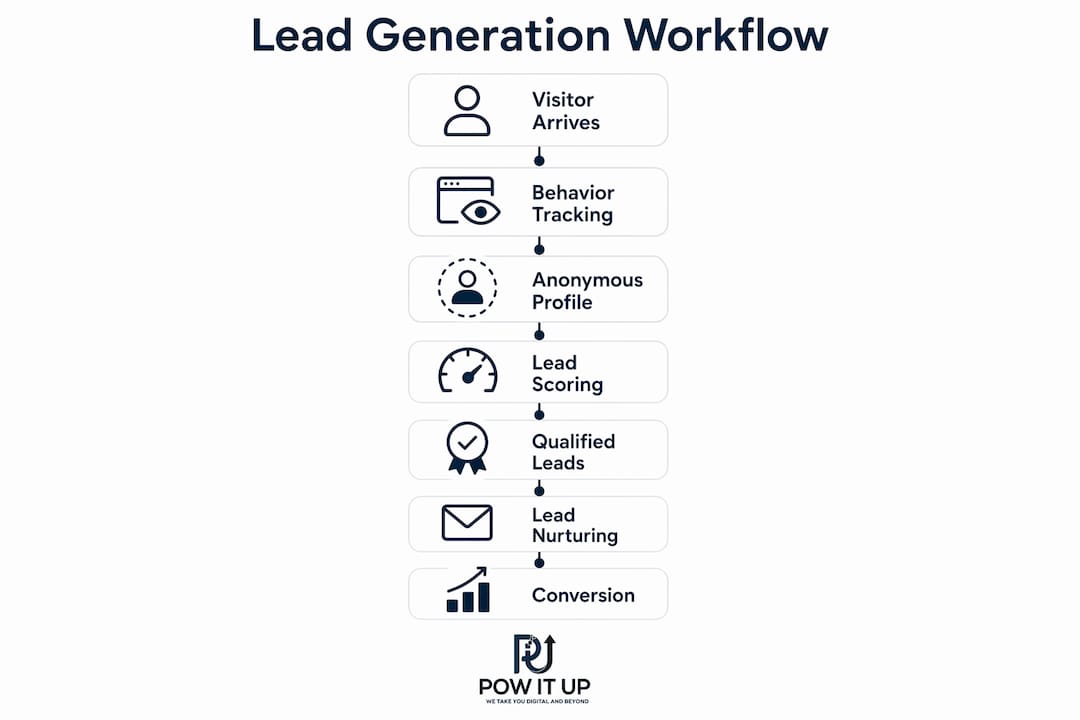
Workflow stage summary
| Stage | Action | Output |
|---|---|---|
| Visitor arrives | Behavioral tracking activates | Anonymous profile created |
| Engagement triggered | Conversational intake starts | Contact data collected |
| Lead scored | Scoring model evaluates behavior | Score assigned |
| Threshold reached | Routing rule fires | Sales rep notified |
| Follow-up initiated | Nurture sequence launches | Lead enters pipeline |
Pro Tip: Set your initial score threshold conservatively. It is easier to lower the bar after reviewing lead quality than to rebuild trust with a sales team that received too many unqualified contacts.
How do you automate lead nurturing for higher conversion rates?
Consistent follow-up is the single biggest gap between businesses that close deals and those that lose them. 80% of sales require at least five follow-up contacts to close, yet 44% of salespeople give up after one attempt. Automation closes that gap without adding headcount.
What an effective nurture sequence looks like
- Day 1: Immediate acknowledgment email with a relevant resource tied to the lead’s entry point.
- Day 3: A follow-up email addressing the most common objection for that lead segment.
- Day 7: A LinkedIn connection request or personalized video message from the assigned rep.
- Day 14: A case study or social proof asset matched to the lead’s industry.
- Day 21: A direct call-to-action: book a call, request a demo, or claim an offer.
AI makes personalization at this scale practical. AI Discovery analyzes prior communication history to tailor each follow-up, maintaining a human tone across hundreds of simultaneous sequences. The result is that every lead feels like they are getting individual attention, even when the system is running autonomously.
“The biggest mistake in lead nurturing is treating every prospect the same. Automated sequences that adapt to a lead’s behavior and communication history outperform generic drip campaigns because they respond to what the lead actually does, not just when they signed up.”
Pro Tip: Review your nurture sequence analytics every 30 days. If open rates drop after message three, the content or timing needs adjustment. Automation does not mean set-and-forget.
What are the most common mistakes in lead generation automation?
Most automation failures trace back to process errors, not technology failures. The tools work. The workflows often do not.
-
Keeping static forms as the primary capture method. A 6–12 field form wall is a documented lead killer. Conversational intake removes the friction that causes drop-offs. Businesses that do not make this switch leave the majority of their inbound traffic uncaptured.
-
Building a nurture sequence and never updating it. Buyer behavior changes. A sequence written in january may be irrelevant by july. Schedule a quarterly review of every active workflow.
-
Using a lead scoring model that never evolves. If your product pricing, target market, or sales cycle changes, your scoring model must change with it. A static model routes the wrong leads to sales and erodes trust between marketing and sales teams.
-
Over-automating without human checkpoints. Automation handles volume. Humans handle judgment. High-value leads, enterprise accounts, and complex objections need a real person in the loop. Build escalation rules that flag these cases automatically.
-
Skipping CRM integration. Automation that does not write to your CRM in real time creates data silos. Sales reps end up working from incomplete records, and the efficiency gains disappear.
The fix for most of these mistakes is the same: document your process before you automate it. Automation amplifies what already exists. A broken process runs faster and breaks more things.
How do you scale and refine your automated lead system?
Scaling automation is not about adding more tools. It is about measuring what works and expanding it deliberately.
Start by tracking four metrics every week: total leads captured, lead-to-opportunity conversion rate, cost per qualified lead, and sales cycle length. These four numbers tell you where the system is performing and where it is leaking. Automation drives measurable lead growth, better quality leads, productivity gains, and long-term cost savings when measured consistently.
Use A/B testing on your highest-volume touchpoints. Test subject lines in nurture emails. Test the opening question in your conversational intake. Test the timing between follow-up messages. Small improvements in these areas compound across thousands of leads.
Expand to new channels only after your core workflow is stable. Voice-based conversational capture, LinkedIn outreach sequences, and SMS follow-ups each add reach. Adding them before your email and web workflows are dialed in creates complexity without return.
Align your automation with your sales team’s evolving priorities. If your team shifts focus to a new vertical or buyer persona, update your scoring model, your intake questions, and your nurture content to match. Automation that reflects your current strategy generates service business ROI that compounds over time.
Key Takeaways
Lead generation automation produces the highest returns when conversational capture, behavioral scoring, and persistent follow-up sequences operate as a single connected system.
| Point | Details |
|---|---|
| Automation drives measurable growth | Automated nurturing generates 50% more sales at 33% lower cost than manual processes. |
| Replace static forms immediately | Conversational intake captures 3–6 times more leads by removing the high-friction form wall. |
| Follow-up volume determines close rates | 80% of sales need 5+ touches; automation ensures no lead gets abandoned after one contact. |
| Score and route leads in real time | Behavioral scoring removes manual triage and gets the right leads to sales faster. |
| Measure and adjust every 30 days | Nurture sequences and scoring models must evolve with buyer behavior and product changes. |
The follow-up gap is where most revenue gets lost
I have worked with enough business owners to know that the technology is rarely the problem. The problem is follow-up discipline. Or the lack of it.
Most teams I talk to have some form of lead capture in place. They have a form, maybe a chatbot, possibly a CRM. What they almost never have is a system that reliably follows up five, six, or seven times without someone manually deciding to do it. That gap is where revenue disappears.
The shift from static forms to conversational intake is real and the numbers back it up. But the bigger shift is cultural. When you automate follow-up, you stop relying on individual sales reps to remember to send the third email. The system does it. That consistency is what separates businesses that close at 20% from those closing at 8%.
My honest caution: do not automate before you have clarity on your process. I have seen companies deploy expensive platforms on top of undefined workflows and wonder why the leads are not converting. The automation did exactly what it was told. The problem was what it was told to do.
Start with one workflow. Get it right. Measure it for 60 days. Then expand. The custom AI agents that drive the best results are built on top of clear, tested processes, not rushed deployments.
— Sameer Abbas
How POWITUP builds automated lead generation systems that scale
POWITUP designs and deploys custom AI-driven lead generation systems for business owners who need results, not experiments.
POWITUP’s team of technical architects builds end-to-end workflows covering conversational capture, behavioral scoring, CRM integration, and multi-channel nurture sequences. Every system is built to your specific sales process, not a generic template. If your current lead generation relies on manual follow-up or static forms, POWITUP replaces those bottlenecks with autonomous, context-aware workflows that run without constant oversight. Explore POWITUP’s AI integration services to see how a purpose-built system can replace the manual work that is costing you qualified leads every day.
FAQ
What is lead generation automation?
Lead generation automation is the use of software and AI to automatically capture, score, qualify, and nurture potential customers without manual intervention at each step. It replaces manual prospecting and follow-up with self-running workflows connected to your CRM and sales process.
How much can automation increase lead volume?
Marketing automation users report a 451% increase in qualified leads through systematic nurturing. Switching from static forms to conversational intake alone captures 3–6 times more leads from the same traffic.
What is the difference between lead capture and lead nurturing?
Lead capture is the process of collecting contact information and behavioral data from prospects. Lead nurturing is the follow-up process that moves those prospects toward a buying decision through personalized, timed communication sequences.
How many follow-ups does it take to close a sale?
80% of sales require at least five follow-up contacts to close. Automation handles this volume consistently, which is why automated nurture sequences outperform manual outreach in both volume and conversion rate.
When should a business start automating lead generation?
A business should automate lead generation as soon as it has a defined buyer persona, a working CRM, and a documented lead-to-sale process. Automating before those elements exist amplifies process gaps rather than fixing them.