

A data analytics consulting firm is a specialized service provider that transforms raw organizational data into strategic decisions through expert architecture, governance, and analysis. The global data analytics consulting market reached $26.37 billion in 2025, and that figure reflects how central these firms have become to enterprise strategy. Business intelligence consulting, data science consulting services, and predictive analytics work are no longer optional upgrades. They are the infrastructure behind every defensible executive decision. This guide explains how these firms operate, what separates good ones from expensive ones, and how to select the right partner for your organization in 2026.
What does a data analytics consulting firm actually do?
The core function of any analytics consulting agency is to move an organization from data collection to data-driven decisions. That sounds simple. The execution is not.
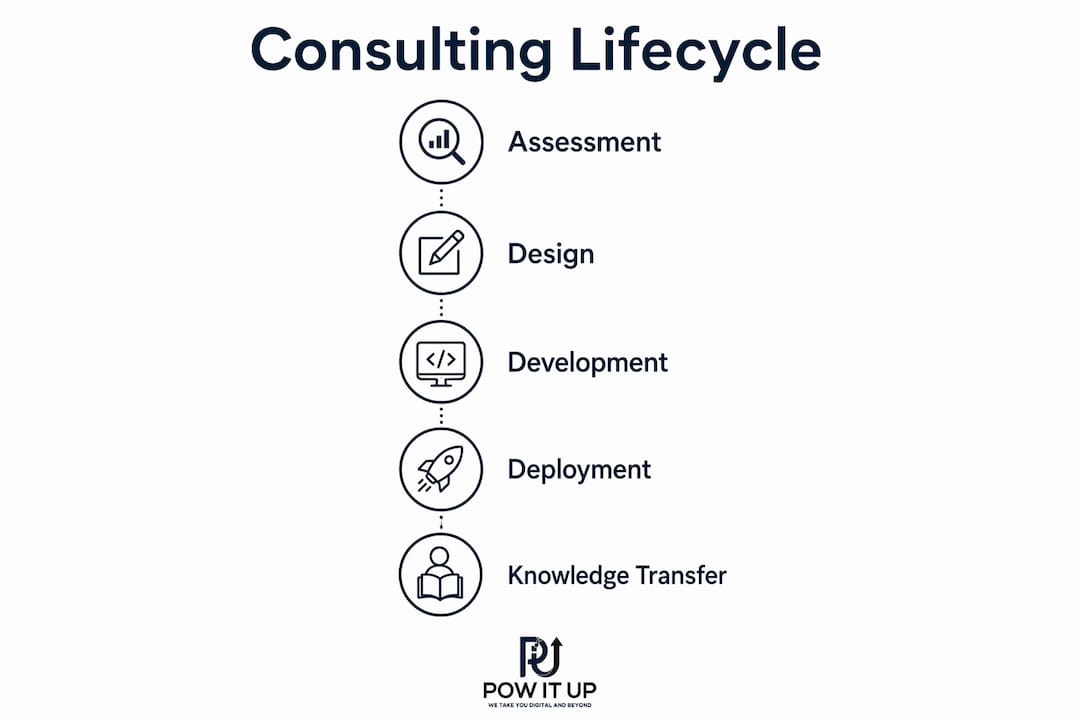
Most firms operate through a four-stage engagement lifecycle: data maturity assessment, architecture and governance design, model development, and insight delivery. Each stage builds on the last. Skipping the assessment phase to jump straight to dashboards is the single most common reason analytics projects fail and produce negative ROI over a multi-year horizon. The assessment stage reveals where your data lives, how clean it is, and whether your infrastructure can support the analysis you actually need.

Architecture and governance design is where most business leaders underestimate the complexity. A data governance framework defines who owns which data, how it flows between systems, and what rules apply to its use. Without this layer, even the best predictive analytics firm will build models on a foundation that breaks under real operational load.
Model development covers the actual analytical work: building machine learning models, statistical analyses, and business intelligence dashboards. Insight delivery is the final stage, where findings are translated into formats executives can act on, whether that is a Power BI dashboard, a weekly automated report, or a live decision-support tool.
Consulting vs. managed services: which model fits your needs?
The delivery model you choose shapes your long-term risk profile. Consulting engagements are time-bounded and focused on strategy and architecture, while managed services provide ongoing pipeline operations and governance. That distinction matters enormously when you are planning post-engagement operations.
| Model | Best For | Key Risk |
|---|---|---|
| Time-bounded consulting | Strategy, architecture, one-time transformation | Knowledge walks out the door at project end |
| Managed services | Ongoing pipeline, governance, reporting | Vendor dependency and reduced internal capability |
| Hybrid engagement | Transformation plus transition to internal team | Requires strong handover documentation |
Pro Tip: Before signing any contract, ask the firm to describe their knowledge transfer process. If they cannot name specific handover documents, runbooks, and training sessions, you are buying a black box.
How do analytics firms solve AI implementation challenges?
92% of U.S. and Canada organizations face AI implementation challenges, according to RSM’s 2025 Middle Market AI Survey. That number tells you that struggling with AI adoption is not a sign of organizational failure. It is the norm. The question is whether you have the right partner to work through it.
Effective data analytics consulting services address these challenges across four dimensions:
- Data infrastructure: Many organizations run analytics on fragmented systems. A consulting firm assesses whether your current stack, whether that is Snowflake, Databricks, or a legacy SQL warehouse, can support the analytical workload you are planning.
- Structured data strategy: A data strategy consulting engagement defines what data you collect, how you store it, and how it connects to business outcomes. Without this, AI models train on noise.
- Ongoing training: Analytics tools are only as useful as the people interpreting them. Firms that deliver training alongside technical builds produce measurably better adoption rates.
- Privacy and compliance architecture: Server-side tracking, GDPR compliance frameworks, and consent management are now baseline requirements, not optional add-ons.
The RSM survey finding also implies something most vendors will not say directly. Effective analytics consulting must cover strategy, infrastructure, training, and support together. Firms that deliver only dashboards without addressing the underlying data quality and team capability problems are selling you a report, not a solution.
Pro Tip: Ask any prospective analytics partner to walk you through a past client’s data infrastructure before and after engagement. If they cannot show concrete architectural changes, they are likely a reporting shop, not a strategy firm.
How should you select a data analytics consulting firm?
Selection is where most organizations make expensive mistakes. A 15-point ROI evaluation framework gives business leaders a structured method for comparing firms on measurable criteria rather than sales presentations.
The most critical selection criteria fall into three categories:
Outcome definition: Define your success metrics before you issue an RFP. If you cannot describe what a successful engagement looks like in numbers, you cannot evaluate whether a firm delivered it. Metrics might include forecast accuracy improvement, reduction in reporting cycle time, or revenue attributed to a new analytics capability.
Architecture compatibility: Evaluate architecture first to understand cost, scalability, batch versus streaming data handling, schema evolution, and failure recovery. A firm that cannot explain how their proposed architecture handles failure scenarios is not ready for production environments.
Pilot-to-scale evidence: Ask every candidate firm for a case study that shows a pilot project that scaled to full production. Pilot success and production success are different problems. Firms that only show pilot results may not have the operational depth to sustain long-term delivery.
Additional procurement criteria worth scoring in your RFP:
- Tool agnosticism: Does the firm recommend the right tool for your environment, or do they default to their preferred vendor?
- Governance enforcement: Can they show examples of data governance policies they have written and implemented, not just recommended?
- Security certifications: SOC 2, ISO 27001, or equivalent certifications signal that the firm treats your data with the same rigor they expect from you.
Using a standardized evidence pack during vendor evaluation, including company profiles, case studies, security certifications, sample deliverables, and delivery cadence documentation, helps you defend your selection decision internally and reduces the risk of selecting on presentation quality rather than delivery capability.
What modular services do analytics consulting firms offer?
Specialist analytics consulting agencies typically structure their services as modular components rather than monolithic projects. This approach lets you start with a focused engagement and expand as your internal capability grows.
Common service modules include analytics audits, Google Analytics 4 setup, server-side tracking, business intelligence dashboards, and structured training programs. Each module addresses a specific measurement or decision-enablement problem.
An analytics audit is the diagnostic layer. It maps your current tracking implementation, identifies gaps between what you are measuring and what you need to measure, and produces a prioritized remediation plan. GA4 setup and server-side tracking address data collection reliability and privacy compliance simultaneously. Server-side tracking moves data collection off the browser, which reduces the impact of ad blockers and improves data accuracy by 15–30% in most implementations.
BI dashboards, built in tools like Microsoft Power BI, Tableau, or Looker, translate cleaned and modeled data into executive-facing views. The difference between a good dashboard and a bad one is not visual design. It is whether the underlying data model reflects how the business actually operates.
Integrated analytics programs covering audit, tracking taxonomy, data warehousing, server-side tracking, attribution, experimentation, and GDPR compliance produce the most reliable measurement foundations. Partial implementations, where a firm sets up dashboards without addressing tracking quality or governance, create a false sense of analytical confidence. Executives make decisions on data they believe is accurate when it is not.
For organizations exploring how AI integration connects to analytics infrastructure, the distinction between a reporting layer and a decision-support system becomes especially important. AI-powered analytics require clean, governed, well-structured data pipelines to function reliably.
Key takeaways
Selecting the right analytics consulting partner requires matching the firm’s delivery model, technical depth, and governance capability to your organization’s specific maturity level and post-engagement plans.
| Point | Details |
|---|---|
| Follow the four-stage lifecycle | Skipping assessment or governance design is the leading cause of analytics project failure. |
| Match delivery model to internal capability | Choose consulting for transformation and managed services for ongoing operations based on your team’s post-engagement readiness. |
| Define success metrics before the RFP | Measurable KPIs set before delivery begins are the only reliable way to evaluate consulting ROI. |
| Demand deployable deliverables | Require architecture blueprints, pipeline code, and runbooks at each milestone, not just reports. |
| Evaluate architecture before tools | A firm’s approach to scalability, failure recovery, and schema evolution predicts long-term production success. |
What i have learned about analytics consulting partnerships
After working across dozens of data and AI engagements, the pattern I see most often is this: organizations hire analytics firms for the output and forget to negotiate for the infrastructure. They receive a polished dashboard at the end of a six-month engagement, the consulting team leaves, and within 90 days the dashboard is stale because no one internally knows how to update the underlying data pipeline.
The firms that deliver lasting value treat knowledge transfer as a primary deliverable, not an afterthought. I have seen RFP checklists for big data vendors that specify assessment reports, architecture blueprints, data dictionaries, pipeline code, and handover documents as contractual milestones. That level of specificity is not bureaucratic overhead. It is the difference between a consulting engagement that compounds in value and one that evaporates.
My honest advice to any executive evaluating a data analytics consulting firm: do not let the conversation stay at the strategy level. Push into the specifics of what you will own at the end of the engagement. Ask to see sample runbooks. Ask who trains your team and when. Ask what happens if a data pipeline breaks six months after the engagement closes.
The firms that answer those questions confidently are the ones worth hiring. The ones that redirect to case studies and methodology decks are selling you a presentation, not a partnership. Analytics consulting that integrates into your long-term digital transformation strategy produces compounding returns. A one-time report does not.
— Sameer Abbas
How Powitup approaches analytics and AI integration
Powitup operates as a strategic technical architect, not a reporting vendor. If your organization has invested in data analytics consulting and still finds that insights are not translating into operational decisions, the gap is usually in the connection between your analytics layer and your automated workflows.
Powitup designs and deploys custom AI agents that connect directly to your data infrastructure, turning analytical outputs into automated operational responses. Where a traditional analytics consulting agency stops at the dashboard, Powitup builds the systems that act on what the dashboard shows. For executives ready to move from AI integration strategy to production-grade deployment, Powitup’s team brings the architecture depth and governance rigor that separates real transformation from expensive experimentation. Explore Powitup’s full analytics and automation services to see how these capabilities apply to your specific operational context.
FAQ
What is a data analytics consulting firm?
A data analytics consulting firm is a specialized service provider that designs, implements, and governs data systems to help organizations make better strategic decisions. These firms typically deliver services across assessment, architecture, model development, and insight delivery.
How is consulting different from managed analytics services?
Consulting engagements are time-bounded and focused on strategy and architecture, while managed services provide continuous pipeline operations and governance. The right choice depends on your internal team’s capability to operate the systems after the engagement ends.
What should i demand in an analytics consulting contract?
Require concrete deliverables tied to milestones, including architecture blueprints, pipeline code, data dictionaries, and handover runbooks. Contracts that specify only hours and reports leave you with no recourse if the engagement produces non-deployable outputs.
How do i evaluate an analytics firm’s technical depth?
Start with architecture questions: ask how they handle schema evolution, batch versus streaming data, and failure recovery. Firms that cannot answer these questions in specific terms are unlikely to build production-grade systems.
Why do so many AI analytics implementations fail?
92% of organizations in the U.S. and Canada report AI implementation challenges, primarily due to fragmented data infrastructure, lack of governance, and insufficient training. Effective consulting addresses all three, not just the analytical output layer.