

AI agents for small businesses are autonomous software systems trained on your specific services, pricing, and brand voice to handle repetitive tasks, customer interactions, and lead management without human intervention. The industry term for this category is agentic AI, and it covers everything from simple chatbots to multi-step workflow orchestrators. Small businesses that deploy these systems cut operational costs by 35–45% within 90 days. That number reflects real labor savings, not theoretical projections. This article breaks down the top AI agent solutions, what each one does, and how to choose the right fit for your operation.
1. What are AI agents for small businesses?
AI agents are software programs that perceive inputs, make decisions, and take actions without waiting for human instruction. Unlike basic chatbots that follow rigid scripts, agentic AI systems reason through context and adapt their responses. For a small business, that means a single agent can qualify a lead, book an appointment, send a follow-up email, and update your CRM, all without you touching a keyboard. The practical result is that you get the output of a full-time employee at a fraction of the cost.
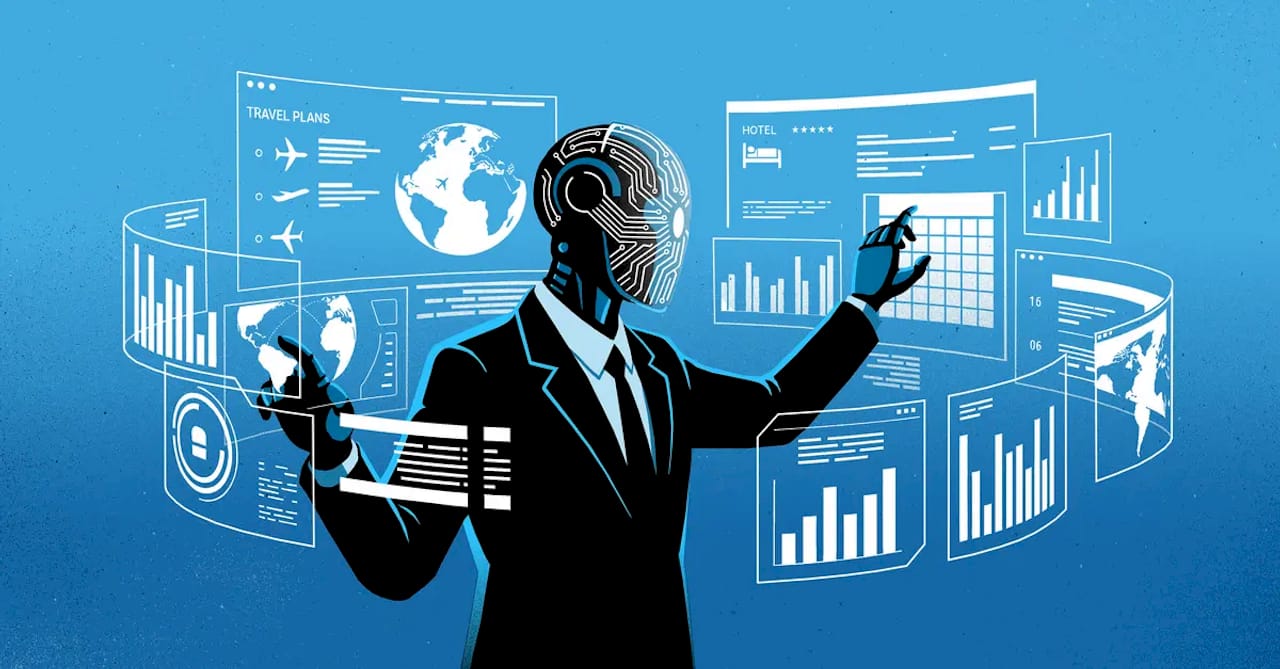
2. Top 10 AI agents every small business should consider
The right AI agent depends on your biggest operational bottleneck. Below are ten proven options, each with a distinct strength.
Salesforce Agentforce
Salesforce Agentforce uses no-code digital blueprints to automate back-office processes including invoice auditing, employee onboarding, and procurement. Its orchestration engine manages both humans and systems together, escalating issues automatically when something falls outside normal parameters. This is the right pick if you already run Salesforce CRM and want to extend automation into operations without writing code.
-
Automates invoice auditing and procurement workflows
-
Escalates exceptions to human staff automatically
-
No-code setup reduces IT dependency
Lapu AI
Lapu AI operates directly on your desktop, not just through cloud APIs. It can work inside spreadsheets, local apps, and web browsers the same way a human operator would. Critically, it runs on your local device and does not send internal data to third-party clouds. That privacy advantage matters for businesses handling sensitive client information.
-
Automates multi-step tasks across desktop and web apps
-
Keeps data local, no third-party cloud exposure
-
Fills automation gaps that API-only tools cannot reach
ScaleForge
ScaleForge deploys multi-channel AI agents across your website, Instagram DMs, and Facebook Messenger in 7–10 days. It integrates directly with your CRM and runs automated follow-up sequences. Businesses using this setup report a 30–50% reduction in no-shows for appointments. If lead capture and appointment booking are your pain points, ScaleForge is built for exactly that.
-
Live on multiple channels in under 10 days
-
CRM integration with automated follow-up
-
Multi-channel analytics dashboard included
Microsoft Copilot Studio
Microsoft Copilot Studio lets you build custom AI agents that connect to Microsoft 365, Teams, SharePoint, and Dynamics 365. You can design agents that answer internal HR questions, process customer requests, or pull data from your business systems on demand. It is the strongest option for businesses already inside the Microsoft ecosystem. The Copilot Studio platform gives you a visual builder with no coding required for basic deployments.
-
Deep integration with Microsoft 365 and Dynamics
-
Visual no-code agent builder
-
Handles both internal and customer-facing tasks
Tidio
Tidio combines live chat, AI chatbot, and email automation in one platform. It is one of the most accessible AI customer service solutions for small firms because setup takes under an hour and pricing starts at a level most small businesses can absorb. Tidio’s AI, called Lyro, handles up to 70% of customer questions automatically. That frees your team to focus on complex issues that actually require human judgment.
-
Lyro AI handles routine customer questions automatically
-
Combines chat, email, and chatbot in one tool
-
Fast setup with no technical background required
Intercom Fin
Intercom Fin is an AI agent built specifically for customer support. It reads your help documentation, product pages, and past support tickets to answer customer questions with accurate, sourced responses. Fin escalates to a human agent when it cannot resolve an issue. For e-commerce and SaaS businesses, Fin reduces support ticket volume significantly without degrading customer experience.
-
Trained on your existing documentation automatically
-
Escalates complex issues to human agents
-
Reduces support ticket volume measurably
HubSpot AI Agents
HubSpot’s AI agents sit inside its CRM and marketing platform, handling lead scoring, email drafting, and pipeline management. If you use HubSpot already, activating its AI features costs nothing extra on most plans. The agents monitor deal stages and prompt your sales team when a lead goes cold. This is the best AI software for small firms that want automation without switching platforms.
-
Built into HubSpot CRM at no additional cost on most plans
-
Automates lead scoring and deal stage monitoring
-
Drafts follow-up emails based on contact history
Zapier AI Agents
Zapier’s AI agents connect over 7,000 apps and can execute multi-step workflows triggered by specific events. You describe what you want in plain language, and the agent builds the automation. For small businesses that use a patchwork of tools, Zapier AI agents act as the connective tissue that makes everything work together. It is not the deepest solution for any single task, but it is the most flexible for cross-app automation.
-
Connects 7,000+ apps with natural language instructions
-
Triggers multi-step workflows from any event
-
No coding required for most use cases
Drift (now Salesloft)
Drift, now part of Salesloft, specializes in conversational marketing. Its AI agents engage website visitors in real time, qualify them based on your criteria, and route hot leads directly to your sales calendar. Small businesses lose 20–40% of potential leads due to slow response times. Drift eliminates that gap by responding instantly, around the clock.
-
Qualifies and routes leads in real time
-
Books meetings directly into your sales calendar
-
Operates 24/7 without human oversight
Chatbase
Chatbase lets you build a custom AI agent trained on your own documents, PDFs, and website content. You upload your materials, and the agent answers questions based only on that content. It is one of the most affordable AI-driven solutions for startups that need a branded, accurate customer-facing agent without a large budget. Deployment takes less than a day for basic configurations.
-
Trained on your uploaded documents and website
-
Affordable entry point for startups and solo operators
-
Deployable in under 24 hours
Pro Tip: Start with the one task that costs you the most time each week. Deploy one agent to own that task completely before adding a second. Stacking agents before the first one is stable creates confusion and poor results.
Pro Tip: Ask every vendor for a sandbox demo using your actual data, not their sample data. An agent that performs well on generic inputs may fail on your industry-specific terminology.
How to choose the right AI agent platform for your small business needs
The single most important factor in platform selection is integration fit. An agent that cannot connect to your existing CRM, scheduling tool, or e-commerce platform will create more work, not less. Before evaluating features, map every tool your business currently uses and confirm which AI platforms connect to them natively.
Budget is the second filter. AI agent costs range from $150 to $3,000 per month depending on complexity and channel coverage. Basic setups deploy in 5–7 days. Advanced integrations take 2–4 weeks. Set a realistic budget before you start demos, and factor in setup fees, which vendors often bury in the fine print.
Key selection criteria to evaluate:
-
Multi-channel support: Can the agent operate on your website, social DMs, and email simultaneously?
-
Customization depth: Can you train it on your specific products, services, and tone?
-
Escalation logic: Does it hand off to a human gracefully when it hits its limits?
-
Data privacy: Where does your data go, and who has access to it?
-
Reporting: Does it give you visibility into what the agent is doing and where it fails?
The most common mistake small business owners make is choosing the most feature-rich platform instead of the most relevant one. A platform with 200 features you will never use is a worse investment than a focused tool that solves your specific problem well.
Pro Tip: Before signing any contract, ask the vendor: “What does a failed interaction look like, and how does your system handle it?” The answer tells you more about platform maturity than any feature list.
Cost and ROI insights for small businesses deploying AI agents
The cost comparison between AI agents and human staff is stark. A customer service AI agent managing 80% of routine inquiries costs roughly $2,800 annually compared to $42,000 for a full-time representative. That is a $39,200 annual saving from a single deployment. For a business running on tight margins, that difference is transformational.
| Cost Factor | AI Agent | Human Staff |
|---|---|---|
| Annual cost (customer service) | ~$2,800 | ~$42,000 |
| Availability | 24/7, all channels | Business hours only |
| Deployment time | 5–28 days | 4–8 weeks to hire and train |
| Scalability | Unlimited volume | Requires additional hires |
| ROI timeline | 90 days typical | 12+ months to break even |
McKinsey data shows that businesses with fewer than 500 employees achieve 240–320% ROI on AI agent investments within 18 months when implementation is done correctly. That ROI comes from three sources: direct labor savings, increased lead conversion, and faster customer service resolution. Businesses that see the weakest returns are those that deploy agents without clear success metrics or without training the agent on accurate, current business data.
61% of small businesses report measurable productivity improvements within 90 days of deploying AI agents. That figure aligns with the cost reduction data and confirms that the ROI timeline is short relative to most technology investments.
Emerging features and future trends in AI agents for small businesses
The next wave of AI agents for business operations moves well beyond cloud-based chat. Desktop-native agents like Lapu AI represent a significant shift. These systems operate across local applications, spreadsheets, and non-API software, which means they can automate tasks that previously required a human sitting at a computer. For businesses with legacy software or specialized local tools, this capability opens up automation that was previously impossible.
Agentic process automation is the broader trend to watch. Instead of automating a single task, these systems handle complex, multi-step workflows that span multiple departments. An agentic system might receive a client inquiry, pull the client’s history from your CRM, generate a quote, send it for approval, and schedule a follow-up call, all without human input at any step.
“Operators underestimate AI agents when limited to API-only cloud apps, but advanced desktop-native agents enable automation of manual tasks involving local data and non-API desktop applications.” — Lapu AI for Operators
The practical implication for small businesses is that your AI agent can eventually function as a digital operational staff member, not just a customer-facing chatbot. Platforms like Salesforce Agentforce already demonstrate this with their orchestration engines that coordinate both human and automated workflows. The businesses that build this infrastructure now will have a structural cost and speed advantage over competitors who wait. You can explore the types of AI agents available for service teams to understand which category fits your operation best.
Key takeaways
AI agents for small businesses deliver the highest ROI when deployed against specific, high-volume tasks with clear success metrics and proper data training from day one.
| Point | Details |
|---|---|
| Cost advantage is immediate | A single AI agent replaces $39,200 in annual labor costs for routine customer service tasks. |
| ROI arrives fast | Businesses under 500 employees see 240–320% ROI within 18 months with correct implementation. |
| Platform fit beats feature count | Choose the agent that integrates with your existing tools, not the one with the most capabilities. |
| Desktop agents expand scope | Tools like Lapu AI automate local and non-API workflows that cloud-only agents cannot reach. |
| Start narrow, then scale | Deploy one agent on your highest-volume task before adding additional automation layers. |
Why I think most small businesses are still thinking about AI agents the wrong way
Most small business owners I talk to approach AI agents as a cost-cutting tool. That framing is not wrong, but it is incomplete. The owners who get the most out of these systems treat them as capacity builders. They are not replacing people. They are removing the ceiling on how much work the business can process without adding headcount.
The mistake I see repeatedly is deploying an agent on a low-stakes task to “test it out.” That approach produces underwhelming results and leads owners to conclude that AI agents are overhyped. The correct move is to identify your single most painful, repetitive, high-volume task and put the agent there first. That is where the ROI shows up fast enough to justify the next deployment.
Data quality is the hidden variable that determines whether an agent performs well or embarrasses you in front of customers. An agent trained on outdated pricing, incorrect service descriptions, or inconsistent brand voice will produce outputs that damage trust. Before you deploy anything, audit the content you plan to train the agent on. Clean data produces capable agents. Messy data produces a liability.
The other thing I would push back on is the expectation that AI agents eliminate the need for human judgment. They do not. What they do is remove the routine work that was consuming your judgment. When your team stops spending four hours a day answering the same 12 customer questions, they have four hours to work on problems that actually require thinking. That is the real value. The service business ROI examples that actually hold up over time are the ones where owners reinvested that recovered time into growth, not just cost reduction.
— Sameer Abbas
Ready to deploy a custom AI agent for your business?
Powitup designs and deploys custom AI agents built around your specific workflows, not generic templates. Whether you need a 24/7 lead qualification agent, a customer service system, or a back-office automation layer, Powitup builds it to fit your tools, your data, and your brand voice.
Most deployments go live in under two weeks. Powitup’s team handles the architecture, integration, and training so you do not have to manage a technical project on top of running your business. If you are ready to stop losing leads to slow response times and start scaling without adding headcount, explore Powitup’s AI integration services or review the full range of intelligent automation options available for small businesses today.
FAQ
What are AI agents for small businesses?
AI agents are autonomous software systems that handle tasks like customer service, lead qualification, and workflow automation without human input. They are trained on your business-specific content to respond accurately across multiple channels.
How much do AI agents cost for a small business?
AI agent platforms typically cost $150–$3,000 per month depending on complexity and channel coverage. Basic setups deploy in 5–7 days, while advanced integrations take 2–4 weeks.
What ROI can a small business expect from AI agents?
Businesses with fewer than 500 employees report 240–320% ROI within 18 months with proper implementation, driven by labor savings, higher lead conversion, and faster customer service.
Can AI agents replace human employees entirely?
AI agents handle high-volume, repetitive tasks effectively but cannot replace human judgment on complex or sensitive decisions. The strongest results come from using agents to free your team for higher-value work.
How fast can an AI agent go live for my business?
Multi-channel AI agents integrated with CRM and automated follow-up can launch in 7–10 days with the right implementation partner, according to deployment data from current AI integration providers.