

Enterprise automation services are the strategic application of integrated technologies and governance frameworks that transform complex organizational workflows into scalable, efficient processes. The term covers everything from Robotic Process Automation and AI-driven decision engines to cloud workflow orchestration and compliance controls. Platforms like NiCE demonstrate that combining these layers with proper governance produces measurable gains: faster deployment cycles, lower operating costs, and processes that scale without adding headcount. If you lead operations, finance, or technology at a mid-to-large organization, this guide gives you the framework to act.
What are enterprise automation services?
Enterprise automation services are structured programs that integrate multiple automation technologies, governance models, and professional services to replace or augment manual work across an entire organization. The industry often uses the term Business Process Automation (BPA) interchangeably, but enterprise-grade programs go further. They include compliance controls, cross-system integration, and organizational change management that departmental tools simply do not address.
The scope separates enterprise automation from small business solutions. A small business might automate invoice emails with a single tool. An enterprise automates the full accounts payable cycle, connecting SAP or Oracle ERP, a document processing AI, a compliance audit trail, and a human-in-the-loop approval workflow, all governed by role-based access controls. That complexity requires a different class of service.
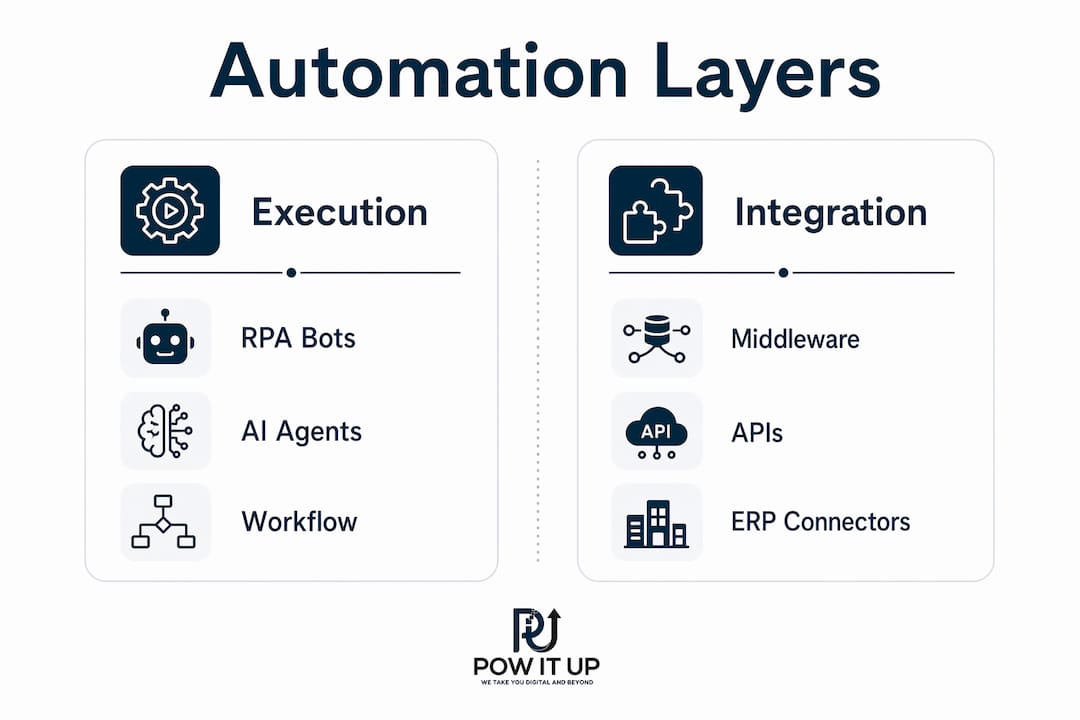
Three technology layers typically define the stack: automation execution (RPA bots, AI agents), integration middleware (APIs, event buses), and governance infrastructure (audit logs, version control, access management). Each layer must work in concert. When one layer is weak, the entire program stalls at scale.

What capabilities define enterprise-grade automation?
Enterprise automation requires multi-tenant governance with role-based access control and SOC 2-compliant security, including data encryption at rest and in transit. That requirement alone disqualifies most consumer or SMB automation tools from enterprise deployments. Security cannot be bolted on after the fact. Native architectural features like version control, rollback, and RBAC are essential because bolt-on security features typically fail audits.
The core capabilities that distinguish enterprise automation services include:
- Multi-tenant governance: Separate access tiers for business units, IT, and compliance teams, with full audit trails on every workflow change.
- Deep API integration: API-depth connectivity with legacy ERP systems, cloud SaaS platforms, and proprietary internal applications is what separates enterprise solutions from point tools.
- AI model version control: The ability to roll back an AI model or workflow to a previous state when a production issue surfaces, without manual intervention.
- Real-time monitoring: Live dashboards that surface bottleneck alerts, SLA breaches, and exception queues before they become business incidents.
- Auditable AI decisions: Every automated decision must produce a record that a compliance officer or regulator can review. Auditable AI decision records are essential to scale in regulated industries.
Pro Tip: Before evaluating any automation platform, ask the vendor to show you their audit log interface and their rollback procedure. If either answer takes more than two minutes to demonstrate, the governance architecture is not production-ready.
The integration depth requirement deserves special attention. Legacy ERP systems like SAP S/4HANA, Oracle E-Business Suite, and Microsoft Dynamics 365 were not designed for modern API consumption. Enterprise automation services must include integration specialists who understand both the legacy system’s data model and the modern automation layer’s event structure. That expertise is rarely available off the shelf.
Why does an automation center of excellence matter?
An Automation Center of Excellence (CoE) is a dedicated cross-functional team that owns the automation platform strategy, sets governance standards, provides internal consulting to business units, and tracks portfolio outcomes across the organization. Without one, automation programs fragment into isolated pilots that never scale.
The performance gap between organizations with and without a CoE is significant. Enterprises with an Automation CoE achieve 60% faster time-to-value and 40% lower maintenance costs. Those numbers reflect the compounding benefit of reusable components, shared governance, and centralized expertise that a CoE produces over time.
“Governance often determines success or failure in enterprise automation. Real-time visibility and auditable AI decision records are not optional features. They are the foundation that allows you to scale.” — NiCE Enterprise Automation Research
A CoE typically owns four responsibilities. First, it defines automation standards so every team builds bots and workflows in a consistent, maintainable way. Second, it runs an internal consulting practice that helps business units identify and prioritize automation candidates. Third, it manages the automation platform itself, including licensing, upgrades, and security patches. Fourth, it tracks ROI across the entire portfolio and reports to executive leadership.
Establishing a CoE before scaling is a critical success factor. Organizations that skip this step and deploy automation directly into business units consistently hit governance bottlenecks at the 20–30 bot mark. At that point, no one owns the standards, bots break silently, and the program loses executive confidence. Rebuilding trust after a failed pilot costs far more than building the CoE correctly from the start.
Automation CoEs provide standards, internal consulting, and portfolio oversight that accelerate success across the entire organization, not just in the first department that adopted automation.
RPA vs. IPA vs. agentic AI: which approach fits your needs?
Comparing RPA, IPA, and Agentic AI reveals increasing levels of decision-making capability and complexity. Each approach solves a different class of problem, and most mature enterprise programs use all three in combination.
| Technology | Decision-Making | Best Use Case | Complexity |
|---|---|---|---|
| RPA (Robotic Process Automation) | Rule-based only | Structured, repetitive tasks like data entry and report generation | Low |
| IPA (Intelligent Process Automation) | AI-assisted, uses ML and NLP | Semi-structured tasks like invoice matching, claims triage, and customer intent routing | Medium |
| Agentic AI | Contextual and dynamic | Complex, multi-step decisions like contract review, exception handling, and adaptive customer service | High |
RPA is the foundation. It executes deterministic tasks by following explicit rules, interacting with UIs and APIs exactly as a human would. Automation Anywhere, UiPath, and Microsoft Power Automate are the dominant platforms in this category. RPA delivers fast ROI on high-volume, structured work but breaks when the underlying process changes.
Intelligent automation combines AI techniques such as machine learning and natural language processing with automation to reduce errors and accelerate manual work. IPA adds judgment to the execution layer. An IPA system can read an unstructured vendor invoice, extract the relevant fields, match them against a purchase order, and flag discrepancies, all without a human touching the document.
Agentic AI represents the current frontier. These systems execute contextual decisions dynamically, adapting their behavior based on real-time data and prior outcomes. A well-designed AI agent can manage a customer escalation end to end: reading the complaint, checking the account history, applying a resolution policy, and drafting a response, without a predefined script. Powitup builds exactly this class of system for enterprise clients.
Pro Tip: Start your automation program with RPA on your highest-volume, most stable processes. Add IPA where documents or unstructured data create bottlenecks. Reserve agentic AI for processes where the decision logic changes frequently or where exceptions outnumber standard cases.
How do you implement enterprise automation successfully?
Successful implementation follows a disciplined sequence. Skipping steps, especially early governance steps, is the primary reason enterprise automation programs stall after the first few deployments.
- Map your processes before touching any tool. Document every step, decision point, and exception path for your target processes. Identify where time actually goes. Most organizations discover that 20% of process steps consume 80% of the labor.
- Prioritize use cases by ROI and feasibility. Score each candidate process on volume, rule-based structure, error rate, and strategic value. Start with high-volume, stable processes where RPA delivers fast payback.
- Stand up your governance infrastructure first. Configure your RBAC model, audit logging, and version control before deploying a single bot. This is the step most organizations skip and later regret.
- Build your CoE in parallel with your first deployment. Use the first project to establish standards, document lessons learned, and train your internal consulting team.
- Define KPIs before go-live. Measure cycle time, error rate, cost per transaction, and exception volume. Without a baseline, you cannot prove ROI to leadership.
After go-live, the work continues. Continuous optimization requires monitoring KPIs weekly, reviewing exception queues for patterns, and updating workflows when underlying systems change. You can explore automation ROI examples from real deployments to benchmark your expected returns.
The compliance and security standards must be locked in from day one. Retrofitting SOC 2 controls or data residency requirements into a live automation program is expensive and disruptive. Engage your security and legal teams during the process mapping phase, not after the first bot is in production.
Professional services matter more in enterprise automation than in almost any other technology category. The integration work alone, connecting your automation layer to legacy ERPs and proprietary systems, requires specialists who understand both sides of the connection. Trying to build that expertise internally from scratch adds 12–18 months to your program timeline.
Key takeaways
Enterprise automation services succeed when governance is built first, technology is matched to process complexity, and a dedicated CoE owns the program from day one.
| Point | Details |
|---|---|
| Governance before tools | Build RBAC, audit logs, and version control before deploying any automation. |
| CoE drives scale | Organizations with an Automation CoE achieve 60% faster time-to-value and 40% lower maintenance costs. |
| Match technology to complexity | Use RPA for structured tasks, IPA for document-heavy work, and agentic AI for dynamic decisions. |
| Integration depth is non-negotiable | Enterprise automation must connect natively to legacy ERP and proprietary systems, not just cloud SaaS. |
| Measure from day one | Define cycle time, error rate, and cost per transaction baselines before go-live to prove ROI. |
Why the tool-first trap destroys enterprise automation programs
I have watched dozens of enterprise automation initiatives launch with enormous enthusiasm and collapse within 18 months. The pattern is almost always the same. A business unit discovers RPA, runs a successful pilot on one process, and then the organization declares victory and starts deploying bots everywhere without a governance model. Six months later, bots are breaking silently, no one knows who owns what, and the IT team is fielding incident tickets they cannot trace.
Treating automation as tool-first rather than governance-first causes most enterprise automation failures. That finding matches everything I have seen in practice. The organizations that get this right treat their first automation project as a governance project that happens to produce a working bot, not the other way around.
The legacy system integration challenge is also consistently underestimated. Connecting a modern AI agent to a 15-year-old ERP system is not a weekend project. It requires people who understand the ERP’s data model at a deep level and who can build stable, monitored integration layers that do not break when the ERP vendor releases a patch. Skimping on this expertise is the second most common reason programs stall.
My honest advice: invest in your AI integration capabilities before you invest in automation volume. A well-integrated, well-governed program with 10 bots outperforms a poorly governed program with 100 bots every time. Organizational change management is the final piece most leaders underestimate. Automation changes jobs. People resist what they do not understand. Communicate early, train affected teams, and involve frontline workers in process mapping. Their knowledge of exceptions and edge cases will save you months of rework.
— Sameer Abbas
How Powitup builds enterprise automation that actually scales
Enterprise automation programs fail when they are treated as technology projects rather than organizational transformation programs. Powitup approaches every engagement as a strategic technical architect, not a vendor selling licenses.
Powitup designs, builds, and deploys custom digital workforces using autonomous, context-aware AI agents that handle high-volume transactional operations and surface operational inefficiencies your team cannot see. From custom RPA builds and IPA deployments to full agentic AI systems, Powitup covers the entire stack. That includes the governance infrastructure, the legacy system integration work, and the ongoing monitoring that keeps programs healthy after go-live. If you are ready to scale processing volumes without scaling headcount, explore Powitup’s enterprise AI automation services or review the full service portfolio to find the right starting point for your organization.
FAQ
What are enterprise automation services?
Enterprise automation services are structured programs that combine RPA, AI, workflow automation, and governance frameworks to automate complex business processes across an entire organization. They differ from SMB solutions by requiring compliance controls, legacy system integration, and organizational governance structures.
Why do enterprises need an automation center of excellence?
An Automation CoE provides the governance standards, internal consulting, and portfolio oversight that prevent automation programs from fragmenting into unmanaged pilots. Organizations with a CoE achieve 60% faster time-to-value and 40% lower maintenance costs compared to those without one.
What is the difference between RPA and intelligent process automation?
RPA executes rule-based, structured tasks by following explicit instructions, while Intelligent Process Automation adds machine learning and natural language processing to handle semi-structured data and make AI-assisted decisions. Most enterprise programs use both in combination.
How long does enterprise automation implementation take?
A well-governed first deployment typically takes 3–6 months, including process mapping, governance setup, integration work, and testing. Programs that skip governance setup and rush to deployment often spend 12–18 months fixing the resulting problems.
What security standards should enterprise automation platforms meet?
Enterprise automation platforms must meet SOC 2 compliance requirements and support data encryption at rest and in transit, role-based access control, and full audit trails. Bolt-on security features typically fail audits; security must be native to the platform architecture.